This is a reprint of an article a wrote for the Newsletter of the Woods & Wetlands Group of the Sierra Club.
In a constant quest to be ever-greener, (sorry I couldn't resist the pun), I was wondering whether it was better to get an artificial Christmas tree or a real one. Unabashed tree hugger that I am, I have never been able to bring myself to cut down a real tree to decorate my home for a few weeks despite the fresh pine aroma and beautiful appearance. However, I have recently questioned the wisdom of importing an artificial tree from China and was doing a mental life cycle analysis when I came across this article entitled, "Which is Greener a Real or Fake Christmas Tree" by Brian Howard from the Good Housekeeping "Consumer's Guide to Green" which answered the question to my satisfaction:
http://www.thedailygreen.com/environmental-news/latest/christmas-trees-picking-greenest-options-synd2?src=nl&mag=tdg&list=nl_dgr_got_hol_120111_greenest-xmas-tree-options&kw=ist
They also had a nice set of articles they call, "Everything You Need for Happy Green Holidays"
http://www.thedailygreen.com/green-homes/latest/green-christmas-holidays-2007-451120?click=main_sr
One of my personal favorite sites, "Practically Green" (www.practicallygreen.com) also has blog posts on "Gift Guide for a Practically Green Holiday", "Guide to Gift Wrap that's Eco-Friendly and Free", "Holiday Cards: Eco & Easy, Entertaining or Elegant - and Energy Saving", "12 Reasons to Shop Local - on Small Biz Saturday and Every Day!" & "Corporate Holiday Gifts" (http://blog.practicallygreen.com/category/green-celebrations/)
They also have a fantastic quiz you can take rating how green and sustainable you are living your life which ranks you on a scale from "barely green", "lightly green" through "impressively green", "wickedly green" to the ultimate "superbly green". The questions are pretty hard core including whether or not you reuse your greywater. No matter what level you score, they offer you suggestions as to the next steps you could take to live even more sustainably.
On Earth 911's web page entitled, "Green-Your-Holidays" you will find articles on "7 resolutions with a Green Twist", "2009 Holiday Gift Guide" which includes gifts made from recycled materials to fair trade practices and "Cleaning up Your Cooking" with eco-friendly and sustainable tips on buying, cooking and cleaning your food for the holidays and always.
http://earth911.com/seasonal/green-your-holidays/
The Sierra Club also has a great page they aptly call, "Green Holiday Tips" (http://www.sierraclub.org/tips/holidays.aspx) which includes a link to the "Sponsor a Wild Place" page where you can, not only find a cool and unique gift giving option, but have the satisfaction of knowing that your gift will help preserve America's wilds legacy. (and who can resist the Arctic Wildlife Refuge adorable stuffed polar bear?)
Lastly, consider giving the gift of an experience, volunteering or reusing a gift. Consider giving a friend or loved one the gift of your time, some help or perhaps that knickknack they have long admired which has outlived it's usefulness for you.
I'll share a reuse experience/experiment I did 2 years ago. My, then 6 year-old, daughter was mad about Barbies. I, like most parents, wanted to indulge her yearning but was also confronting my own rampant consumerism. In the spirit of reuse, I decided to purchase 1 new Barbie so that she'd have something new and contracted to purchase several used Barbies from a few of my students. The students were glad to resell the Barbies they had outgrown and get a little extra money for their own gift giving. By Christmas Day, I had about 14 Barbies total, 11 of which had all of their limbs all for about $10. The students were so excited about the deal that they threw in various extra items of clothing, a few cars and a small Barbie house. I put the Barbies with the missing parts in a bag and set them aside and gave her the remaining collection.
She was beside herself with excitement when she saw them and showed absolutely no preference for the new Barbie over the used ones. Several days later she found the bag with what we now refer to as the "physically challenged" Barbies and was a little miffed that I had been holding out on her. She taught me a valuable lesson that Christmas. Instead of the usual m.o. of overindulging our children in consumerism, maybe we can have Christmas be a teachable moment?"
Sunday, December 11, 2011

Tuesday, September 7, 2010
Visit to the Berkeley, CA recycling center
On a visit today to the City of Berkeley, CA recycling center/transfer station, I met with Tania Levy, Associate Management Analyst. The City of Berkeley was one of the first municipal recycling centers in the country and the transfer center and recycling facility are owned by the City of Berkeley and operated by The Ecology Center and Community Conservation Center. BTW, The City of Berkeley also uses Priuses for their city cars. How cool is that?
The Ecology Center is a community based, non-profit which operates Berkeley's curbside recycling program and uses these cool split hauling trucks (see photo) and split bins which ask customers to split their recyclable discards into fiber (paper) on one side and cans and bottles in the other. Here's a link to their website: http://www.ecologycenter.org/
The Community Conservation Center, another non-profit runs the recycling center. Here's an excerpt from their site: "Community Conservation Centers (CCC) has been operating Berkeley Recycling at Second and Gilman Streets in Berkeley since September 1982. CCC operates programs that buy recyclables and provides for convenient drop-off of recyclables. The City-owned facility is also home to the Ecology Center, which operates the residential curbside pick-up program. The City of Berkeley operates the commercial pick-up program which collects recyclables from commercial establishments throughout the city. Together, the three programs collect about 18,000 tons per year of various materials, including newspaper, cardboard, glass and plastic bottles, scrap metals and household hazardous waste. The following are programs operated by CCC." (http://berkeleyrecycling.org/page.php?id=8).
I had been referred to Tania by Neil Seldman and Tania has a long history in recycling and anti-incineration activism. Tania suggested several things both for IFLC and for the Lake County Recycling Task Force.
#1. She suggests subscribing to Biocycle Magazine (http://www.jgpress.com/biocycle.htm) and reading Sally Brown's articles. (Several other recycling experts wholeheartedly agree)
#2. She said we should bring a composting expert onto our team.
#3. Consider finding an agricultural ally who can help us promote using composted materials and help develop aftermarkets for food-scrap compost. Conventional agricultural practices depend heavily upon petroleum products. Using compost conserves water in the soil, and promotes healthier, stronger plants which are better positioned as global warming increases. I know that Illinois State University's dept of Agriculture has a learning farm which is interested in composting. Perhaps that's a source?
#4. Contact the US Composting Council.
She said the main composting facility (food scrap and landscape waste) they use is Grover Landscape Services which is approx. 90 miles away from them. This means that a compost facility would not necessarily have to be in Lake County. Here's an article about Grover's composting facility: http://www.jgpress.com/archives/_free/001708.html
Alameda County, California recycling history:
California passed AB939 (http://www.calrecycle.ca.gov/Laws/Legislation/calhist/1985to1989.htm) in 1989 which, among other things, changed from a "County Solid Waste Management Plan" to "Integrated Waste Management Planning" and asked each county to "establish a task force to coordinate the development of city Source Reduction and Recycling Elements (SRREs) and a countywide siting element". They also "required each city or county plan to include an implementation schedule which shows: diversion of 25 percent of all solid waste from landfill or transformation facilities by January 1, 1995 through source reduction, recycling, and composting activities; and, diversion of 50 percent of all solid waste by January 1, 2000 through source reduction, recycling, and composting activities." This, as I understand it, laid the groundwork for what was to follow.
Next, several local recycling activists in Alameda County wrote, proposed and passed "Measure D" also known as the "Almeda County Waste Reduction and Recycling Initiative", a proposition which required that they could charge $7 per ton to fund recycling and waste reduction efforts in the county as they felt AB939 was essentially an unfunded mandate. Stop Waste told me that every one $ per ton they charge costs the consumers approx 7 cents per month.
Here's a link to Stop Waste's page which has the download for the measure: http://www.stopwaste.org/home/index.asp?page=512
It's a great read for anyone (read Garbage Geeks) interested in recycling programs.
Here's an excerpt:
The people of Alameda County find and declare that:
A. The increasing consumption of single-use and environmentally harmful products depletes natural resources, produces huge quantities of refuse -- most of which is disposed of in ways that damage the environment -- and, ultimately, will injure future generations;
B. The use of terms such as "garbage" and "solid waste" result from -- and serve to reinforce wasteful attitudes; the materials referred to by these terms retain their value as natural resources, and should instead be described and treated as "'discarded materials" to be recycled rather than incinerated or landfilled;
C. At least ninety percent of the discarded materials generated within Alameda County are landfilled (almost exactly the same as Lake County's) as are vast quantities of discarded materials from neighboring counties; existing landfill capacity in the Bay Area will be exhausted in less than twenty-five years, while new landfills are increasingly difficult and expensive to site; landfill is neither a long-term, nor a sustainable, nor an environmentally safe option for disposal of discardedmaterials;(sound familiar?)
D. Refuse incinerators are a poor alternative to source reduction and recycling: such incinerators damage the environment by wasting natural resources that could instead be recycled, by accelerating the release of greenhouse gasses -- which worsen global warming -- and by generating toxic substances;
E. Each person discards materials and should therefore be involved in solving the problems caused by the disposal of such materials; this involvement must include changes in individual behavior resulting from each person's awareness of her or his role in creating or finding solutions to environmental problems; only through such changes can sustainable consumption and disposal patterns be established and the biosphere restored:
F. The County government shares a responsibility with Alameda County cities and sanitary districts to provide a comprehensive source reduction and recycling program which will foster these necessary changes in individual behavior as well as ensure that the goals set by state law are met; and
G. The best available method for funding the Recycling Plan is a surcharge on materials disposed of at landfills.
Hats off to the people of Alameda County for passing this measure!
The last thing I learned from Tania is that Pay-as-you-Throw works great in the short term, but as they became more efficient at recycling, they were receiving less income and ran into some trouble. They are considering a fixed charge to all households as a base and then adding pay as you throw on top of that. This gives them a somewhat fixed income.
More later from Tom Padia, the Source Reduction and Recycling Director for StopWaste, "the Alameda County Waste Management Authority and the Alameda County Source Reduction and Recycling Board operating as one public agency."
Photos:
City of Berkeley's organics collection 9/8/10, Ecology Center's split truck, a dual sort recycling bin to go with the split truck, Berkeley's battery and fluorescent light collection (2), a 3 hour haul for Urban Ore salvagers from the transfer station (more on Urban Ore later this week), the floor of the City of Berkeley's transfer station.
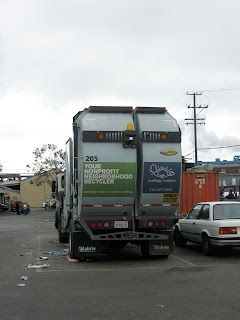


The Ecology Center is a community based, non-profit which operates Berkeley's curbside recycling program and uses these cool split hauling trucks (see photo) and split bins which ask customers to split their recyclable discards into fiber (paper) on one side and cans and bottles in the other. Here's a link to their website: http://www.ecologycenter.org/
The Community Conservation Center, another non-profit runs the recycling center. Here's an excerpt from their site: "Community Conservation Centers (CCC) has been operating Berkeley Recycling at Second and Gilman Streets in Berkeley since September 1982. CCC operates programs that buy recyclables and provides for convenient drop-off of recyclables. The City-owned facility is also home to the Ecology Center, which operates the residential curbside pick-up program. The City of Berkeley operates the commercial pick-up program which collects recyclables from commercial establishments throughout the city. Together, the three programs collect about 18,000 tons per year of various materials, including newspaper, cardboard, glass and plastic bottles, scrap metals and household hazardous waste. The following are programs operated by CCC." (http://berkeleyrecycling.org/page.php?id=8).
I had been referred to Tania by Neil Seldman and Tania has a long history in recycling and anti-incineration activism. Tania suggested several things both for IFLC and for the Lake County Recycling Task Force.
#1. She suggests subscribing to Biocycle Magazine (http://www.jgpress.com/biocycle.htm) and reading Sally Brown's articles. (Several other recycling experts wholeheartedly agree)
#2. She said we should bring a composting expert onto our team.
#3. Consider finding an agricultural ally who can help us promote using composted materials and help develop aftermarkets for food-scrap compost. Conventional agricultural practices depend heavily upon petroleum products. Using compost conserves water in the soil, and promotes healthier, stronger plants which are better positioned as global warming increases. I know that Illinois State University's dept of Agriculture has a learning farm which is interested in composting. Perhaps that's a source?
#4. Contact the US Composting Council.
She said the main composting facility (food scrap and landscape waste) they use is Grover Landscape Services which is approx. 90 miles away from them. This means that a compost facility would not necessarily have to be in Lake County. Here's an article about Grover's composting facility: http://www.jgpress.com/archives/_free/001708.html
Alameda County, California recycling history:
California passed AB939 (http://www.calrecycle.ca.gov/Laws/Legislation/calhist/1985to1989.htm) in 1989 which, among other things, changed from a "County Solid Waste Management Plan" to "Integrated Waste Management Planning" and asked each county to "establish a task force to coordinate the development of city Source Reduction and Recycling Elements (SRREs) and a countywide siting element". They also "required each city or county plan to include an implementation schedule which shows: diversion of 25 percent of all solid waste from landfill or transformation facilities by January 1, 1995 through source reduction, recycling, and composting activities; and, diversion of 50 percent of all solid waste by January 1, 2000 through source reduction, recycling, and composting activities." This, as I understand it, laid the groundwork for what was to follow.
Next, several local recycling activists in Alameda County wrote, proposed and passed "Measure D" also known as the "Almeda County Waste Reduction and Recycling Initiative", a proposition which required that they could charge $7 per ton to fund recycling and waste reduction efforts in the county as they felt AB939 was essentially an unfunded mandate. Stop Waste told me that every one $ per ton they charge costs the consumers approx 7 cents per month.
Here's a link to Stop Waste's page which has the download for the measure: http://www.stopwaste.org/home/index.asp?page=512
It's a great read for anyone (read Garbage Geeks) interested in recycling programs.
Here's an excerpt:
The people of Alameda County find and declare that:
A. The increasing consumption of single-use and environmentally harmful products depletes natural resources, produces huge quantities of refuse -- most of which is disposed of in ways that damage the environment -- and, ultimately, will injure future generations;
B. The use of terms such as "garbage" and "solid waste" result from -- and serve to reinforce wasteful attitudes; the materials referred to by these terms retain their value as natural resources, and should instead be described and treated as "'discarded materials" to be recycled rather than incinerated or landfilled;
C. At least ninety percent of the discarded materials generated within Alameda County are landfilled (almost exactly the same as Lake County's) as are vast quantities of discarded materials from neighboring counties; existing landfill capacity in the Bay Area will be exhausted in less than twenty-five years, while new landfills are increasingly difficult and expensive to site; landfill is neither a long-term, nor a sustainable, nor an environmentally safe option for disposal of discardedmaterials;(sound familiar?)
D. Refuse incinerators are a poor alternative to source reduction and recycling: such incinerators damage the environment by wasting natural resources that could instead be recycled, by accelerating the release of greenhouse gasses -- which worsen global warming -- and by generating toxic substances;
E. Each person discards materials and should therefore be involved in solving the problems caused by the disposal of such materials; this involvement must include changes in individual behavior resulting from each person's awareness of her or his role in creating or finding solutions to environmental problems; only through such changes can sustainable consumption and disposal patterns be established and the biosphere restored:
F. The County government shares a responsibility with Alameda County cities and sanitary districts to provide a comprehensive source reduction and recycling program which will foster these necessary changes in individual behavior as well as ensure that the goals set by state law are met; and
G. The best available method for funding the Recycling Plan is a surcharge on materials disposed of at landfills.
Hats off to the people of Alameda County for passing this measure!
The last thing I learned from Tania is that Pay-as-you-Throw works great in the short term, but as they became more efficient at recycling, they were receiving less income and ran into some trouble. They are considering a fixed charge to all households as a base and then adding pay as you throw on top of that. This gives them a somewhat fixed income.
More later from Tom Padia, the Source Reduction and Recycling Director for StopWaste, "the Alameda County Waste Management Authority and the Alameda County Source Reduction and Recycling Board operating as one public agency."
Photos:
City of Berkeley's organics collection 9/8/10, Ecology Center's split truck, a dual sort recycling bin to go with the split truck, Berkeley's battery and fluorescent light collection (2), a 3 hour haul for Urban Ore salvagers from the transfer station (more on Urban Ore later this week), the floor of the City of Berkeley's transfer station.


Thursday, August 26, 2010
Welcome to our Blog!
Incinerator Free is so excited to welcome you to our new blog. We launched this blog in order to keep you up to date on our travels and efforts in bringing greater recycling and diversion rates to our beautiful county of Lake in Illinois just north of Chicago.
We originally formed in November of 2009 when we found out that Lake County wanted to include the option of incineration in its 5-year solid waste plan. Because we wanted our county to take a more progressive approach to waste disposal, we launched a campaign to educate our county board members on alternatives to incineration.
After months of hard work, petitioning and speaking at county board meetings, we succeeded in April 2010! The county board removed all forms of incineration from the waste disposal plan due to our efforts!
After our victory, the county invited us to be part of a recycling task force and this blog will follow our progress and include posts from research excursions and updates from the recycling task force meetings.
Stay tuned as one of our members heads to California to investigate recycling and zero waste efforts out west!
Subscribe to:
Posts (Atom)